 By TTA Blog
In this ongoing series, Thrust Tech Accessories (TTA) highlights the many different aircraft types presently in service around the world, and its commitment to keeping them in the air. Join us as we explore the roles that venerable aircraft like the Beechcraft Premier I and IA play in the industry, the niches they serve, and the important challenges they face day-by-day, year after year, all across the globe.
We also wish to underscore the key role that Maintenance, Repair and Overhaul service companies (MROs) like TTA play behind the scenes in providing overhaul, repair, and modification of engines and airframe accessory components that keep such aircraft flying properly, safely—and long into the future.
* * * * * * * * * * * *
Hawker Beechcraft Are Still Flying High
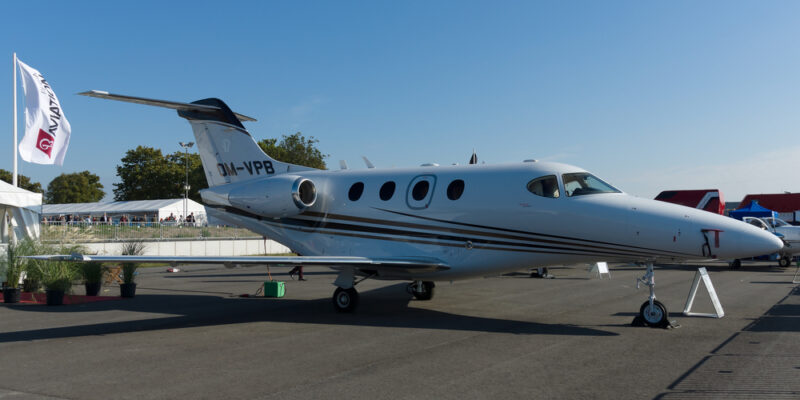
Three decades ago, the Beechcraft Premier 1, a new light business jet project by the Beechcraft Division of Hawker Beechcraft, was positioned for take-off. “The goal was to design and manufacture an innovative, new aircraft type that could effectively compete with the popular Cessna Citation Jet (CJ) aircraft series,” says Stanley Kowlessar, President and General Manager, Thrust Tech Accessories (TTA), an experienced MRO based near Fort Lauderdale Executive Airport in South Florida.
In 1995, plans for the new Premier 1 were officially announced at the National Business Aviation Conference. Described by the company as an “executive office at 41,000 feet,” the first Premier 1 business jet took its inaugural flight in 1998. Prior to launch, the test program involved four different prototypes.
Most notably, in the final version, the fuselage was manufactured with carbon fiber and Nomex-honeycomb composite materials. In addition, the jet’s aluminum wings had panels milled from solid aluminum stock. “As a result, the aircraft was the first-ever composite-fuselage business jet to gain FAA certification, which it attained in 2001,” says Kowlessar.
Carrying a $5 million price tag, the Premier 1 jet began its career in service for corporate, private and charter operators during that same year. Sporting a 46-foot wingspan, the Premier 1 jet can still take off on a runway of 3,792 feet. It can also reach a maximum cruise speed of 451 KTAS (knots true air speed) with a range of 1,365 nautical miles.
In 2006, Hawker Beechcraft then introduced the upgraded Beechcraft Premier IA, priced at $7 million, delivering improved brakes, avionics, and cabin features. With a similar maximum cruise speed to this day, the Premier IA features a 44-foot, 6-inch wingspan and is powered by two Williams International FJ44-2A turbofans with 2,300 pounds of thrust.
Passenger-wise, the Premier 1 jet can carry four people in club seats and two more seated toward the rear of the aircraft. Plus, Premier 1A jets add two executive fold-out tables, a washroom/lavatory and small cabin baggage area.
“Today, both the Premier I and IA are still flying high and can be easily and efficiently operated by a single pilot, so they’re effective workhorses for many aviation operators,” says TTA’s Kowlessar. “Over the years, we’ve developed significant expertise and experience in handling the MRO needs of Beechcraft Premier 1 and Premier 1A operators.”
For instance, TTA’s specialized technicians maintain, repair, or replace hydraulic pumps, ignition exciters, modulating and shutoff valves, starter/generators, wheel speed transducers and pneumatic shutoff valves for the Premier 1 and Premier1A.
In total, 292 Premier 1 and Premier 1A jets were manufactured over the years. Over the years, these business jets have continued to prove their value as a corporate office in the sky. An updated version of this aircraft series, the Beechcraft Premier II, rebranded as Hawker 200 in 2010, was also created to provide even higher speed, greater range, and more payload. But the company’s financial struggles following a national recession eventually halted production.
The Beechcraft Premier 1 and Premier 1A light business jets remain popular workhorses in active service and are highly popular with charter operators because they’re ideal for flights of one to two hours. “We’re here to help with MRO needs for these business jets,” stresses Kowlessar. “We have helped many clients in helping keep these planes in tip-top operating condition and performing day-after-day in corporate, private and charter operations.”
Ensuring Longevity and Reliability
To maintain the Beechcraft Premier I and IA’s operational readiness and extend service life, comprehensive MRO procedures are crucial to ensuring they continue to soar in the skies, meeting the demands of its diverse roles with excellence.
Thrust Tech Accessories is proud of its unique role among the panoply of service providers worldwide that work in concert to keep this aircraft type in great condition.
Routine & Intermediate Maintenance
To ensure aircraft remain airworthy and operational, routine and intermediate maintenance checks are always performed on a scheduled basis. It is during these checks that technicians determine if any worn or damaged components must be replaced or repaired. This is where TTA steps into high gear. Operators around the world can rely on TTA to provide fast-turn maintenance services that aim to prevent system failures, which could lead to unscheduled downtime or in-flight emergencies.
About Thrust Tech Accessories
Thrust Tech Accessories excels in its mission to provide cost-effective MRO measures to meet the specialized needs of the Beechcraft Premier I and IA and other fascinating and storied airframes. The Fort Lauderdale-based company offers capabilities such as testing, repair service, overhaul service, and of course fast turn-around times. TTA supports a number of private and business aircraft operators as well as regional airlines, along with overseas air carriers and rotorcraft operators in numerous countries around the globe.
To find out more about TTA’s wide-ranging capabilities to support your fleet and to obtain competitive program bids, contact us via email at TTAsales@ThrustTech.com or call 954-984-0450.