
 By TTA Blog
As we pass the halfway point of 2026, it’s worth noting that the market demand for global MRO (Maintenance, Repair and Overhaul) services increased to $136 billion last year. Up eight percent from 2024, the market is expected to approach $193 billion by decade’s end, according to Oliver Wyman’s 2026–2036 Global Fleet and MRO Market Forecast.
Tellingly, engine services and requirements remain the largest segment, accounting for roughly half of total MRO spending.
Top executives at several recent key MRO industry conferences across North and South America offered additional salient insights into future opportunities for this important market. The recent ALTA CCMA & MRO Conference in Cartagena, Colombia, is one such example.
Organized by the Latin American and Caribbean Air Transport Association (ALTA), the event brought together the powerful technical procurement industry group of CCMA, the Comité de Compradores de Material Aeronáutico (Aeronautical Material Procurement Committee). Participants included convening MRO service industry leaders and research analysts, along with key decision-makers for the airlines, suppliers, service providers and logistics experts who embody aviation in the region.
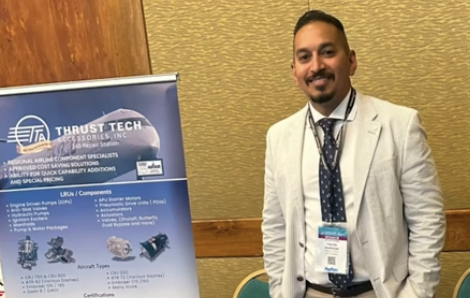
“We learned much from the expert speakers and industry presentations at ALTA CCMA & MRO about what’s ahead,” says Stanley Kowlessar, Sr., president and general manager of Thrust Tech Accessories (TTA), based near Fort Lauderdale Executive Airport. “We also really benefited by connecting in person with top airline, cargo, charter, and corporate executives, valued clients, and potential new ones — discussing new technologies, logistics solutions, and much more.”
Among other insights, participants heard that engine repair wait times have soared 150 percent in recent years, and parts that once took four to six weeks to source may now require 20 to 40-plus weeks.
Adjacent to this, two other challenges dominated the conversation:
1) It’s Critical: More Qualified MRO Technicians Are Needed
The global shortfall of aviation maintenance technicians is already estimated at 30,000 to 40,000, with the U.S. alone short 12,000 to 18,000. Boeing’s 2025 Pilot and Technician Outlook forecasts 710,000 new technicians will be needed globally over the next two decades. A perfect storm of factors is driving this:
- Firstly, airlines, cargo companies, charter operators, and corporate owners have expanded routes and services, requiring bigger fleets and greater aircraft utilization.
- Secondly, aviation manufacturer backlogs exceed 17,000 planes — roughly 12 to 14 years of production — leaving many operators without expected deliveries.
- Thirdly, this means that older aircraft are flying longer as a result, requiring more MRO attention. The average fleet age has risen to 15.1 years, per IATA.
- And lastly, and just as importantly, the median age of a U.S. certificated mechanic is 54, with more than 20 percent over age 64 and 30 to 40 percent expected to retire within 10 years.
“One critical priority is retaining valued team members,” says Kowlessar. “The other is attracting new, younger talent.” TTA strives to do both — offering extended training and education, medical, dental, vision, 401(k), paid time off, recognition programs, promotional opportunities, and enhanced resources.
2) A Continuing Focus is Needed to Relieve Pressure on Parts Supply Chains
The global aviation parts supply chain remains under strain, with shortages and delays driven by raw material scarcity, geopolitical instability, and rising labor costs. At least 38 percent of global MROs have reported issues with incomplete or unverifiable parts documentation in the past year.
“Whether acquiring parts for warehouse storage or rushing a component to a customer who needs it now, we prioritize the integrity and verification of every single part received,” stresses Kowlessar. “Safety, reliability, and regulatory compliance are our top priorities.”
Extended lead times remain a reality. Advance planning and appropriate budgeting are essential strategies for any operator facing potential delays of weeks or months.
During the pandemic, TTA significantly expanded its parts inventory — an investment that continues to benefit clients today by reducing wait times for critical components. “We also offer FAA-approved PMA parts as high-quality alternative solutions,” Kowlessar notes.
Summing It Up
By attending conferences like the ALTA CCMA & MRO Conference, TTA stays current on industry trends and engages in the knowledge sharing that directly shapes how the company serves its clients. “We engage one-on-one in strategic conversations that benefit our clients in how we approach and fulfill their MRO needs — now and into the future,” says Kowlessar.
The global MRO landscape is shifting fast, and what happens in the second half of 2026 will matter to every aircraft owner and operator. Thrust Tech Accessories is ahead of these challenges — with an expanded parts inventory, a skilled and growing team, and the industry expertise and know-how to keep your aircraft airworthy, compliant, and back in the air as quickly as possible.
About TTA
Thrust Tech Accessories (TTA) is a veteran-owned, full-service MRO company specializing in the repair and overhaul of components for private, corporate, and commercial aircraft. Located at 6701B NW 12th Ave., Fort Lauderdale, FL 33309, TTA serves clients around the world with FAA, EASA, and CAA certifications. Learn more at ThrustTech.com or call 954-984-0450.